
How Reading Boosts Early Childhood Brain Development
Parents and caregivers have heard that the first years of life are crucial for a child’s brain development. But did you know that reading with your little one can powerfully boost that early brain growth?
About 90% of a child’s brain growth happens by age 5, making the early years a once-in-a-lifetime window for learning. During this period, a baby’s brain forms over one million new neural connections per second – and positive, language-rich activities like reading aloud are some of the best fuel for this incredible growth.
Reading isn’t just an enjoyable ritual; it’s actually nourishing your child’s brain. Studies show that regularly reading to young children promotes stronger language skills, cognitive abilities, and even emotional security. Below, we’ll explore the science of how storytime helps build your baby’s brain – from firing up neural networks to expanding vocabulary – and why curling up with books is one of the smartest investments you can make in your child’s future.
Rapid Brain Growth in the Early Years
At birth, a baby’s brain is only about a quarter the size of an adult’s. It doubles in size in the first year and reaches approximately 80% of adult size by age 3 and 90% by age 5. This means the experiences a child has in their first few years – including exposure to language and stories – have an outsized impact on how the brain’s architecture is built.
A baby’s brain forms around a million new synaptic connections each second in the early years. These connections lay the groundwork for everything from sensory processing and movement to understanding language and emotions.
Everyday moments of talking, singing, playing, and reading with caregivers provide crucial stimulation that shapes the young brain. Storytime isn’t just sweet bonding – it’s brain-building.
Crucially, the brain connections for higher-level skills like problem-solving, empathy, and self-regulation are also formed (or not) in these early years. Reading books together fosters emotional security, introduces new concepts, and strengthens cognitive growth. Without these nurturing experiences, certain neural pathways may not develop as robustly, making it harder to build those skills later on.
Language Exposure and Brain Development
One of the clearest ways reading boosts brain development is through language exposure. Babies and toddlers absorb the sounds and rhythms of speech long before they can talk. The more words a child hears in early life, the stronger their language skills become.
Children who are regularly read to during the first five years of life hear about 1.4 million more words than those who aren’t. Storybooks introduce new vocabulary and complex sentences that expand verbal ability and comprehension.
Brain imaging studies have shown that children who experience more reading at home display greater activation in brain areas linked to language and imagination. Reading literally strengthens neural circuits responsible for semantic processing and visualization.
The American Academy of Pediatrics (AAP) now recommends parents begin reading from birth. Reading together engages both sides of the communication loop – pointing, reacting, laughing – which supercharges language learning.
> Tip: Repetition is beneficial! Toddlers who hear the same story repeatedly learn more words than those who hear many different ones.
Cognitive Skills and Imagination Soaring
Beyond language, reading also strengthens cognitive skills and nurtures imagination. Board books teach cause-and-effect, colors, and shapes; more complex stories train memory, attention, and prediction.
Asking your toddler questions like “What do you think will happen next?” promotes recall and problem-solving. Storytime helps build executive functions like focus, planning, and self-control.
Reading also fuels imagination. Unlike videos that provide visuals, stories encourage children to create mental images. This process builds creative thinking and empathy – as the brain activates the same regions used for understanding others’ feelings.
Early reading has also been linked to better cognitive performance and larger brain volumes later in life. Every story is a mental playground where your child practices curiosity, reasoning, and emotional understanding.
Emotional Bonding and Stress Reduction
Reading provides powerful emotional and physiological benefits. Studies show that storytelling can increase oxytocin (bonding hormone) and decrease cortisol (stress hormone) in children – literally helping them feel calmer and safer.
The warmth and consistency of reading together strengthens secure attachment, which underpins emotional development. Through these “serve-and-return” interactions – responding to your child’s expressions, questions, or giggles – you’re wiring the brain for trust and resilience.
Reading also teaches emotional literacy. When children see characters feeling scared, sad, or proud, they begin to recognize emotions and practice empathy. Over time, these early experiences shape how children handle feelings, relationships, and stress.
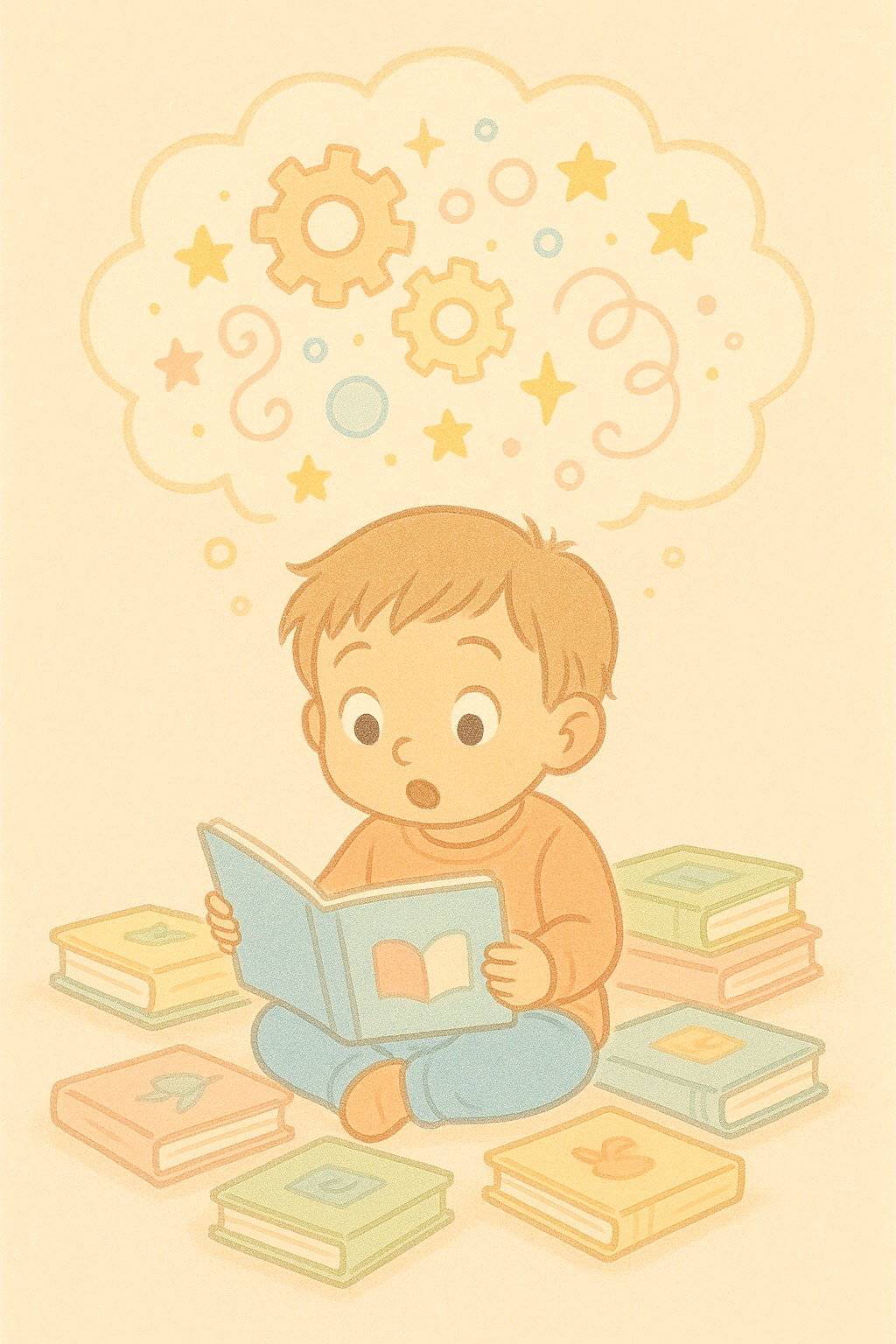
Long-Term Literacy and Learning Foundations
The benefits of early reading compound over time. Children who are read to regularly develop stronger pre-literacy skills and perform better academically.
Storytime builds foundational literacy concepts – recognizing letters, understanding that print carries meaning, and grasping story structure. These skills make the transition from “learning to read” to “reading to learn” much smoother.
Early reading also supports attention span, focus, and discipline, essential for classroom success. Reading proficiency by third grade is a strong predictor of future educational achievement.
Ultimately, instilling a love of reading is one of the greatest lifelong gifts. Kids who see reading as joyful will keep seeking knowledge, exploring ideas, and exercising their minds.
> In summary: Reading is like a multivitamin for early brain development – nourishing language, cognition, emotion, and imagination all at once.
References
- American Academy of Pediatrics – Early Literacy Recommendations
- Pediatrics Study – Home Reading and Brain Activation
- First Things First – Brain Development Research
- PC Utah – Benefits of Reading to Children
- University of Cambridge Study – Early Reading and Cognitive Performance
- Psychology Today – The Science of Storytelling